How Fleets Spec Cab and Chassis Trucks for Sale to Match Their Exact Upfit Needs

Why Spec'ing a Cab and Chassis Right the First Time Protects Your Margin
A wheelbase that runs four inches long. A gross vehicle weight rating that leaves the truck 800 pounds short once the body and a full fuel tank go on. A transmission that will not accept the power take-off the dump hoist needs. Each of these starts as a single line on a spec sheet, written months before the truck ever reaches the upfit bay. Get one wrong and a straightforward body install turns into drilling new mounting holes, re-routing hydraulics, or shipping the chassis back.
For a fleet, that is lost revenue while the truck sits idle, plus the labor to fix what the order should have prevented. Spec'ing a chassis well is the difference between a unit that earns from its first week and one that ties up capital while the shop works around a bad order. The buyers who do this best treat the chassis and the body as one machine, not two purchases that happen to bolt together. They know the body weight, the duty cycle, and the job before they pick a make or a model. At Lynch Truck Center, the conversations that produce trouble-free trucks start with the work the truck has to do, then move to the equipment that does it. The fleets that get it right work through the specs below before they ever compare cab and chassis trucks for sale.
What a Cab and Chassis Truck Is and Why Fleets Order Them This Way
A cab and chassis truck is a complete running vehicle, the cab, engine, transmission, axles, and bare frame rails, delivered with no cargo body behind the cab. The fleet decides what goes on that frame, whether that is a dump bed, a service body truck build, a flatbed, a refrigerated box, or a tow body. Manufacturers build trucks this way because no single body suits every trade. A plumber, an electrician, and a recovery operator can order the same chassis and finish it three different ways.
Fleets order chassis-cab units for control. Buying a pre-built work truck means living with another company's choices on body length, material, and mounting points. Spec'ing your own chassis lets you match the frame to the exact body, and the body to the exact job. It also opens the door to standardizing across a fleet, since one well-chosen chassis platform can carry several body types. Lynch Truck Center stocks chassis from Isuzu, Hino, Ford, Chevrolet, GMC, Ram, and the Class 7 and 8 makes, which is why the commercial truck inventory runs from light service vans up through heavy vocational units ready for upfit.
Spec the Body First, Then Build the Truck Underneath It
Start with the body and the load, then choose the chassis to carry both. Reverse that order and the body has to be cut, shimmed, or re-engineered to fit a frame that was never sized for it. A body builder needs three things before anything else, the weight of the loaded body, the length of the body, and where the heaviest part of the load sits over the frame.
Consider a dump truck. The body weight, the maximum payload of material, and the dump hoist all have to fit inside the chassis ratings with margin to spare. A service body for an HVAC contractor pulls in a different direction, lighter overall, but longer, with compartment depth and a need for clean electrical runs. Each body points to a different wheelbase, a different cab-to-axle dimension, and sometimes a different rear axle rating. Working back from the body keeps every later decision grounded in the actual job. It is also how a dealer avoids the worst outcome, a finished truck that is technically legal but rides nose-high, handles poorly, or carries less than the operator was promised.
Matching GVWR to Real Payload, Not Catalog Numbers
Gross vehicle weight rating is the ceiling, the most a loaded truck can legally weigh, and the number that actually matters to a fleet is what is left after everything but cargo. A chassis rated at 19,500 pounds GVWR does not hand you 19,500 pounds to haul. Subtract the curb weight of the chassis, then the body, then the mounted equipment, the fuel, and the driver, and the remainder is your real payload.
This is where catalog shopping burns people. Two trucks can share a GVWR and offer very different working payloads once a heavy steel dump body goes on one and a light aluminum service body goes on the other. The chassis also carries separate front and rear axle ratings, and those combined ratings can come in below the GVWR. A load placed too far back overloads the rear axle long before the truck reaches its gross rating. Spec the GVWR to the loaded body plus a real-world payload, then confirm the front and rear axle ratings support how that load actually sits. Buyers who skip this step register for a weight class they did not plan on, or run over a rating that voids warranty and invites a roadside citation. Getting the spec and the commercial truck financing right up front avoids the surprise of a weight class you did not plan on, or a rating that voids warranty.
How to Calculate Available Payload After the Upfit
Available payload is GVWR minus everything that is not cargo. Start with the chassis curb weight from the manufacturer's spec sheet, add the dry weight of the body and any mounted equipment such as a crane, liftgate, or hoist, add fuel at roughly seven pounds per gallon, and add an allowance for the driver and a passenger. Whatever sits under the GVWR is what the truck can carry. Run the same math against the rear axle rating, since that is often the tighter limit. A crane mounted behind the rear axle, or a long body loaded toward the tail, puts more weight on the rear than a simple total suggests. Good practice leaves a margin rather than spec'ing to the exact number, because operators rarely load to plan, and a truck sitting at 100 percent of rating has no room for a wet load, a tool upgrade, or a heavier crew. Lynch's sales team runs these figures before an order goes in, so the truck that arrives carries what the operator was told it would.
Wheelbase and Cab-to-Axle, the Dimensions That Decide Body Fit
Cab-to-axle, the distance from the back of the cab to the center of the rear axle, is the single dimension that decides whether a body bolts on as designed. Body builders publish their products by the cab-to-axle they require, an 84-inch service body, a 108-inch flatbed, a 60-inch dump. Order a chassis with the wrong cab-to-axle and the body either hangs off the back with too much overhang or crowds the cab with too little frame to mount to.
Wheelbase and cab-to-axle move together but are not the same measurement. Wheelbase runs axle center to axle center and drives turning radius and ride quality. Cab-to-axle is the working space behind the cab where the body actually sits. A longer cab-to-axle carries a longer body but widens the turning circle and can hurt maneuverability on tight routes and job sites. A shorter one tightens the turn but limits body length. The right answer comes from the body spec and the routes the truck runs. A crew threading tight residential streets wants a tighter package than a flatbed hauling long material on the highway. Pin down the cab-to-axle the body needs first, then confirm the wheelbase delivers the handling the route demands.
After-Frame and Frame Overhang for Dump and Service Bodies
After-frame, the length of frame rail behind the center of the rear axle, controls how the back of the body is supported and how far it overhangs. Too little after-frame and a dump body or flatbed extends past the frame with nothing under it, which stresses the rear and can fail an inspection. Too much and the rail sticks out behind the body, forcing the upfitter to cut and re-finish the steel. Dump bodies are the strict case. The hoist and pivot points have to land in specific spots relative to the rear axle, so the after-frame and the cab-to-axle both have to be right or the body cannot cycle properly. Service and flatbed bodies are more forgiving but still need the rail to support the rear crossmembers. Ordering the chassis with the after-frame the body builder specifies saves the shop from frame surgery, keeps the rear weight distribution where the engineer intended, and protects the factory frame coating that fights corrosion over the life of the truck. It is a small line on the order that pays off every year the truck stays on the road.
PTO and Hydraulic Provisions for Dumps, Cranes, and Liftgates
A power take-off pulls power from the transmission to drive the hydraulics that raise a dump body, swing a crane, or run a snow plow, and it has to be ordered with the chassis rather than added easily later. The power take-off provision tells the factory to install the gear opening, the wiring, and often the controls that let an upfitter connect a pump. Leave it off the order and the shop faces a far harder retrofit, sometimes one the transmission will not cleanly support.
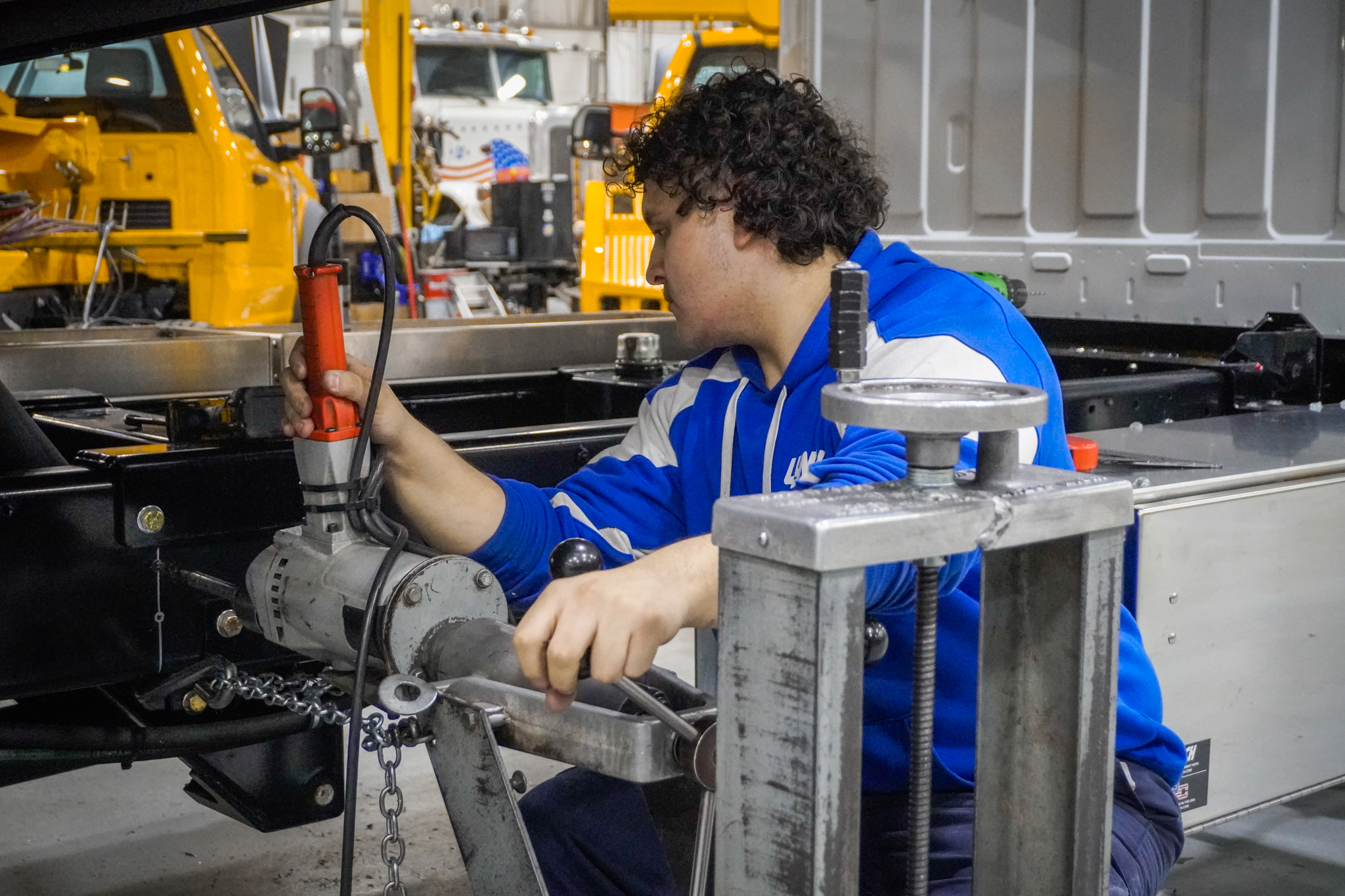
Different bodies pull different amounts of hydraulic flow. A simple liftgate asks for very little. A dump hoist asks for more. A truck-mounted crane or a hooklift needs a power take-off and pump sized to the equipment, plus a wet kit when the work runs continuously. The chassis order has to name the power take-off type, the rotation, and the control method so the body builder's hydraulics match what the truck can deliver. Lynch handles this through its in-house upfit shop, where the team that mounts the body confirms the power take-off and hydraulic spec against it, which keeps the chassis order and the equipment install pointed at the same answer.
How Transmission Choice Shapes Your PTO Options
The transmission decides which power take-off you can run. Automatic transmissions, common on vocational chassis, use specific power take-off apertures and often a hot-shift unit that engages while the truck is moving, which matters for spreading salt or running a crane on the move. Manual transmissions take a different power take-off and usually engage only at a stop. Build the body's hydraulics around one assumption and put the wrong transmission underneath, and the parts simply will not match. This is why the transmission cannot be chosen on fuel economy or driver preference alone. A dump or plow truck that runs hydraulics in motion needs a transmission and power take-off rated for it. A small dump truck that only tips its bed while parked has more freedom. The duty cycle of the hydraulics, how often and how hard they run, sets the requirement. Naming the transmission, the power take-off type, and the hydraulic load together on the order, and confirming all three with the body builder, is what keeps a build from stalling in the shop while someone sources a part that should have been on the spec sheet.
Frame Strength, Section Modulus, and RBM Ratings
Frame strength comes down to two published numbers, section modulus and resisting bending moment, and the heavier or more concentrated the load, the higher both need to be. Section modulus describes the cross-section of the frame rail. Resisting bending moment combines that geometry with the steel's yield strength to express how much bending the frame resists before it deforms. A dump truck dropping loads, a crane applying point loads, or a hooklift levering containers all demand more frame than a flat highway hauler of the same weight.
Manufacturers offer the same chassis with different frame options, single rail, reinforced, or double-channel inserts, and the body application dictates the choice. Under-spec the frame and the rail can crack or sag over years of heavy cycling, which no body mount can fix after the fact. Over-spec it and you have paid for steel and weight you never use, cutting into payload on every load. The body builder's mounting instructions usually state a minimum resisting bending moment. Matching or modestly exceeding it gives a frame that carries the equipment for the truck's full service life without dragging dead weight into every trip. On a heavy vocational build, that single decision separates a frame that lasts from one that becomes the reason the truck retires early.
Body-Builder Electrical Provisions That Cut Install Time
Body-builder electrical provisions are the factory connectors, switch packs, and pre-run circuits that let an upfitter power lights, gates, and controls without cutting into the chassis harness. Ordered up front, they give the shop clean tie-in points, often an in-cab switch bank already wired to bodyside connectors. Left off the order, the installer splices into factory wiring, which is slower, harder to troubleshoot, and a frequent source of electrical gremlins down the road.
Modern chassis run multiplexed electrical systems where splicing can trip faults or disable features, so the provision matters more than it used to. Spec the upfitter interface that matches the body's needs, the number of switches, the circuits for strobes or a liftgate, the connector for trailer or auxiliary lighting. A truck ordered with the right electrical package reaches the shop ready to accept its equipment, which shortens install time and keeps the wiring serviceable for whoever works on it next. For a fleet running many similar units, that consistency pays twice, because a technician sees the same layout truck after truck, which speeds repairs and keeps more of the fleet earning.
Single Rear Wheel Versus Dual Rear Wheel Configurations
Single rear wheel chassis turn tighter and cost less, while dual rear wheel chassis carry more weight and stay planted under heavy or offset loads. The choice follows the payload and the body. A light service body or a contractor setup often lives comfortably on a single rear wheel, which also rides better when empty and fits tighter parking. Put a loaded dump, a heavy crane, or a body that throws weight to one side on that same truck and the dual rear wheel becomes the safer, more capable platform.
Duals raise the rear axle capacity and widen the rear track, which steadies the truck under a high or shifting load and reduces the chance of a blowout stranding the unit. They also add width, weight, and tire cost. The honest answer is set by the work. Fleets comparing cab and chassis trucks for sale should size the rear configuration to the heaviest realistic load the body will carry, not the average day, because the truck has to handle its worst case safely. Spec'ing duals on a truck that never needs them wastes money and payload, while spec'ing singles on a truck that does is a capacity and safety problem you cannot easily undo once the body is on.
Choosing Diesel or Gas for the Duty Cycle
Diesel earns its premium on trucks that run heavy, long, and often, while gas makes more sense on lighter trucks that run shorter routes and sit more than they roll. A heavy dump or a recovery unit pulling loaded grades all day returns the higher diesel purchase price through torque, fuel economy under load, and longer engine life. A light service truck that idles between short hops may never recover the diesel premium, and it carries higher maintenance and emissions-system cost besides.
The deciding factor is the duty cycle, not habit. Annual miles, load weight, hours of power take-off operation, and route profile point clearly toward one engine or the other for most fleets. Gas engines have closed much of the old torque gap in the medium-duty range, which makes them viable on more vocational trucks than they were a decade ago. The cost picture, purchase price, fuel, maintenance, and resale, is also where buying terms come in, and Lynch's commercial truck financing lets a fleet weigh monthly cost against the duty cycle instead of judging the engine on sticker price alone. Match the engine to how the truck actually works and the total cost of ownership tends to take care of itself.
Standardizing Cab and Chassis Specs Across a Growing Fleet
Standardizing means picking a small set of proven chassis-and-body combinations and ordering them again and again rather than spec'ing each truck from scratch. A fleet that runs three configurations instead of fifteen one-offs stocks fewer parts, trains drivers and technicians on fewer layouts, and earns more predictable resale. When a truck goes down, a standardized fleet usually has a near-identical unit to keep the route covered.
The savings compound. Identical power take-off and hydraulic setups mean one set of spare components. Common electrical provisions mean a technician already knows the wiring. Matching wheelbases and bodies mean an upfit the shop has done before, with no surprises. The trade-off is flexibility, since one platform rarely fits every job perfectly, so the aim is a short menu of specs that covers the real work, not a single truck forced onto every task. Fleets buying cab and chassis trucks for sale at volume see the biggest return here, and Lynch's fleet management program helps operators settle on repeatable specs, then build to them order after order so each new truck matches the last.
Building the Truck Around the Work
A chassis spec'd around the body, the payload, and the route arrives ready to earn, while one ordered on price or habit costs more to fix than it ever saved. The fleets that get this right decide what the truck must do before they pick what it is. When you are ready to compare cab and chassis trucks for sale, the team at Lynch Truck Center will work back from the job to the spec, so the upfit drops in clean and the truck is earning the week it lands. Browse the commercial lineup and start the conversation with the work, not the window sticker.