When a GMC Savana Van Beats a Box Truck for Daily Delivery Routes

With cargo volume ranging from 239.4 to 283.6 cubic feet depending on configuration, the GMC Savana van covers a surprisingly wide band of delivery work before a fleet operator needs to step up to a medium-duty box truck. A box truck holds more cargo, but the routes, stops, and loads on a given day may not demand that extra capacity, and the tradeoffs in maneuverability, cost, and driver workload can make the cargo van the smarter tool for the job.
The Decision Behind the Vehicle Choice
Delivery operators choosing between a cargo van and a box truck are really weighing four variables at once: payload class, route type, physical access at each stop, and operating cost per mile. The Savana 2500 Cargo and 3500 Cargo represent two payload tiers within the full-size van category, while a box truck occupies a separate medium-duty class with different licensing requirements, fuel profiles, and turning radius.ii. Cargo volume alone does not settle the decision. A route built around 80 residential stops in a dense metro area and a route built around 12 wholesale drops on a highway corridor demand fundamentally different vehicles, even if the total cubic footage moved in a day is similar. The practical decision point is whether the load weight, stop density, and access conditions of a given route fit within what a full-size cargo van can handle, or whether they push past its limits into box truck territory.
Cargo Capacity and What It Actually Limits
The Savana's 239.4 to 283.6 cubic feet of cargo space handles a wide range of parcel, food service, and last-mile delivery loads without requiring a larger vehicle footprint. Within that range, the 2500 Cargo and 3500 Cargo trims differ in gross vehicle weight rating and payload ceiling, so the 3500 accommodates heavier loads inside the same body dimensions. For operators whose freight is bulky but light, such as boxed consumer goods or bagged supplies, the 2500 may be sufficient. For operators hauling denser freight like cases of beverages or stacked building materials, the 3500's higher weight rating becomes the deciding factor between the two trims.
A box truck carries more cubic volume and a higher payload ceiling, but that capacity comes with a larger footprint, a higher load floor, and in some configurations a requirement for a commercial driver's license. The higher load floor alone changes the physical demand on a driver at every stop, adding time and fatigue across a full shift. The tradeoff is not simply how much fits inside but the combination of payload ceiling, floor height, and the physical access a driver has when loading and unloading dozens of times per day.
Engine Output and Route Demands
The GMC Savana van pairs its standard 4.3-liter V6 with an 8-speed automatic transmission on a rear-wheel-drive platform, producing 276 horsepower at 5,200 RPM and 298 pound-feet of torque at 3,900 RPM. The V6 and 8-speed pairing handles the repeated acceleration and braking cycles of stop-and-go urban delivery without the mechanical complexity of a medium-duty diesel drivetrain. For operators running tight grid routes with frequent stops and short distances between them, the V6 provides adequate power while keeping the vehicle in a familiar service and parts ecosystem.
A 6.6-liter V8 is also available on the Savana, though its specific output figures are not published in current sources. For heavier loads or routes with sustained grades, the V8 is the appropriate selection, but the real-world performance gap between the two engines on a typical delivery route depends on load weight, terrain, and stop frequency in ways that spec sheets cannot fully capture. Box trucks typically run medium-duty diesel engines with higher torque at lower RPM, which suits sustained highway loads and heavy gross weights. The diesel advantage narrows considerably on urban routes where the engine spends most of its time idling or accelerating from a dead stop, and where the added complexity and cost of diesel maintenance eat into the per-stop economics.
Fuel Economy in Daily Route Conditions
No verified fuel economy figures for the Savana's V6 or V8 appear in published specification sources, which means any claim about miles per gallon for this vehicle would be an estimate rather than a tested number. Consumer reviewers describe the Savana as offering good fuel economy for a full-size van, but that characterization lacks a numeric benchmark to anchor it. The Savana does run on regular fuel, which reduces per-gallon cost compared to diesel, but the total fuel expense on a given route depends on load weight, stop frequency, idle time, and driver behavior in ways that a single MPG figure cannot represent.
Box trucks running diesel engines carry their own fuel cost profile that shifts with the same variables. Diesel fuel typically costs more per gallon than regular gasoline, but diesel engines can be more efficient under sustained highway loads. On a high-frequency urban route with heavy idle time, that efficiency advantage shrinks or disappears. Fleet operators evaluating total cost per stop should treat fuel economy as a variable to measure against their actual route data rather than a fixed advantage for either vehicle class. Operators with fleet management services and solutions in place can track fuel consumption across vehicle types more systematically. Running a pilot route with both vehicle types and tracking fuel consumption over a representative period is the most reliable way to settle the comparison for a specific operation.
Maneuverability, Access, and Urban Route Fit
The Savana's full-size van footprint allows access to residential streets, parking structures, loading docks with low overhead clearance, and tight urban blocks where a box truck either cannot fit or must idle in a traffic lane waiting for space to open. On routes with 50 or more stops per shift, the time saved at each stop by being able to pull to the curb, park in a standard space, and move on adds up to a meaningful difference in daily productivity. The 2500 Cargo's 3-door configuration affects how a driver loads and unloads at each stop, and operators should consider whether their freight requires rear-only access or benefits from a side door for mid-route retrieval.
Box trucks offer a walk-in rear compartment and a roll-up door that speeds high-volume stops where a driver is unloading pallets or large quantities of product at a single location. That advantage is real on routes with fewer stops and larger per-stop volumes, such as restaurant supply or wholesale distribution. The tradeoff is a wider turning radius, a longer parking footprint, and limited access to neighborhoods with narrow streets or low-hanging utility lines. Routes with high stop density in dense urban or suburban environments consistently favor the cargo van's maneuverability, while routes with fewer stops and larger per-stop volumes favor the box truck's load access and interior space.
Driver Workload and Safety Features on Route
A driver making dozens of stops per shift accumulates fatigue from repeated lane changes, parking maneuvers, and blind-spot checks. The 2027 Savana addresses that workload with a suite of active safety features including blind-spot alert, a collision warning system, lane departure warning, rear parking sensors, a rear-view camera, stability control, traction control, and hill start assist. Front and rear head curtain airbags and front side airbags round out the passive protection. Together, these systems reduce the cognitive load on a driver who is splitting attention between navigation, delivery logistics, and traffic dozens of times per hour.
One specification worth noting for operators considering mixed-use configurations: child door locks and child seat anchors are not available on the 2027 Savana, which matters for passenger or conversion van buyers but does not affect cargo delivery use. Box trucks vary widely in available safety technology depending on manufacturer and spec level, so a direct comparison on active safety features between the Savana and a specific box truck depends on the box truck's make and trim. Full-size cargo vans tend to inherit more passenger-vehicle safety technology than medium-duty trucks, giving delivery drivers a more car-like safety environment on high-frequency stop routes.
Upfit Options for Delivery Operations
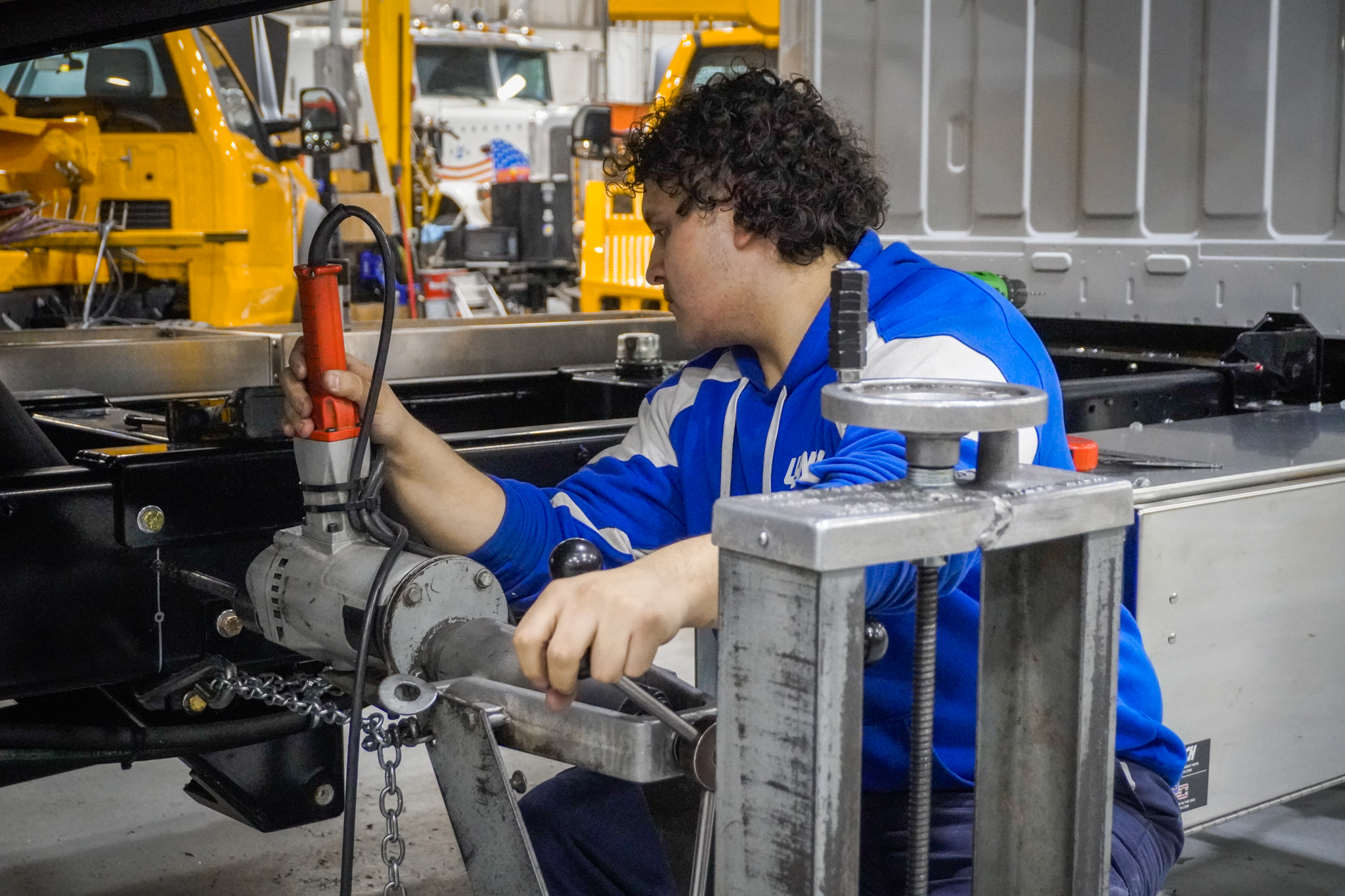
Both cargo vans and box trucks support commercial upfitting, but the Savana's interior dimensions and mounting points determine which shelving, partition, and cargo management systems fit the space. Common upfit work on a GMC Savana van includes shelving units for organized parcel delivery, cargo liners to protect the floor and walls, ladder racks for contractors doubling as delivery operators, and partition walls to separate the driver compartment from the cargo area. These modifications turn a stock cargo van into a purpose-built delivery tool matched to a specific type of freight.
Box trucks support a wider range of body configurations, including refrigerated units for temperature-controlled cargo and hydraulic lift gates for heavy or palletized loads. Operators whose routes require either refrigeration or lift-gate access cannot substitute a Savana for a box truck regardless of how favorable the route density or access conditions might be. Lynch Truck Center's in-house commercial truck upfitting capability covers both commercial van and truck configurations, so operators evaluating either vehicle class can work through the build process with a single team rather than coordinating between a dealer and a separate upfit shop.
Ownership Costs, Warranty, and Fleet Serviceability
The Savana carries a 3-year/36,000-mile basic warranty, a 5-year/60,000-mile powertrain warranty, and a 3-year/36,000-mile corrosion warranty. Consumer reliability reports describe the vehicle as dependable over extended continuous use, with at least one reviewer reporting multi-day nonstop operation with stops only for fuel and rest. Box trucks carry their own warranty terms by manufacturer and chassis, and a direct comparison requires specific make and model data that varies too widely to generalize here.
Fleet serviceability depends on parts availability, service bay compatibility, and technician familiarity with the platform. Operating a mixed fleet of cargo vans and box trucks adds complexity to parts inventory and service scheduling, because the two vehicle classes share almost no common components. Operators running a single platform benefit from consolidated parts sourcing through a commercial truck parts center and a service team that knows the vehicle inside and out. For fleets large enough to justify both vehicle types across different route profiles, maintaining a relationship with a commercial truck service center that handles both classes keeps maintenance streamlined.
Verdicts by Route Type
Urban last-mile routes with high stop density, tight access, and loads within the Savana 3500's payload ceiling favor the cargo van on maneuverability, active safety technology, and driver workload. The van gets into and out of stops faster, costs less to fuel and maintain, and puts less physical strain on a driver across a full shift. Routes requiring temperature-controlled cargo, lift-gate unloading, or loads exceeding the Savana's payload ceiling require a box truck regardless of how favorable the other conditions might be.
Mixed suburban routes with moderate stop counts and mid-range loads sit in a gray zone where the decision depends on per-stop load size and whether the operator prioritizes driver experience or load volume. Fleet operators running multiple route types should evaluate each route individually rather than applying a single vehicle type across the entire operation. A fleet that runs both cargo vans on dense urban loops and box trucks on longer suburban or highway routes gets the best cost-per-stop performance from each vehicle where it fits.
Lynch Truck Center carries new and used light- and medium-duty commercial trucks across its Waterford, Chicago, and Denver locations and can support both van and box truck selections with sales, upfit, parts, and service under one roof. With over 35 years of experience and a Waterford facility spanning more than 40,000 square feet with over 30 service bays, the operation is built to keep commercial fleets running rather than just selling vehicles and moving on. Operators weighing the cargo van and box truck decision for their routes can contact Lynch Truck Center to work through the specs, upfit requirements, and commercial truck financing options for either vehicle class.